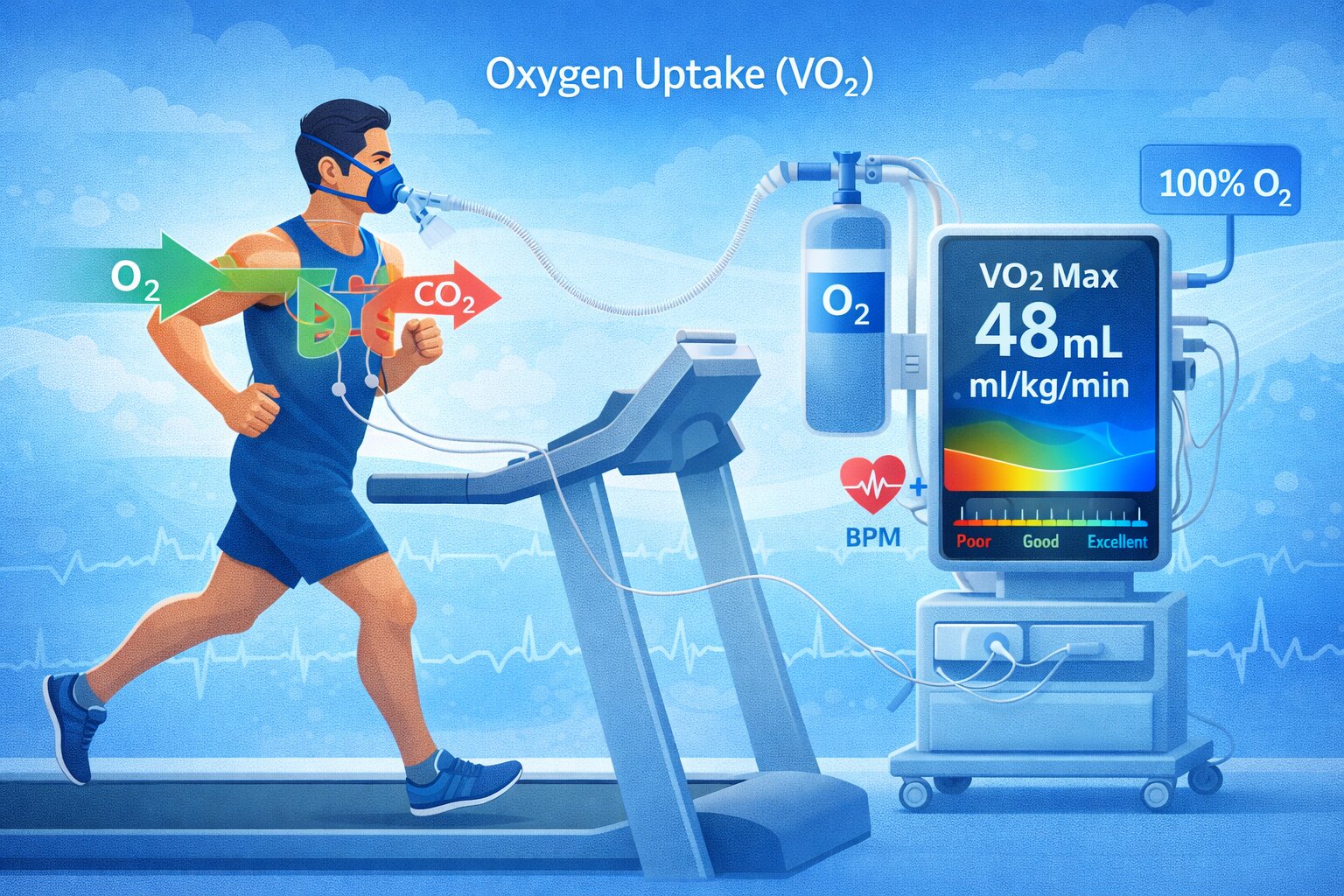
Estimate your VO₂ max (maximal oxygen uptake) using the 12-minute Cooper test.
Enter your age, gender, and the distance you covered in 12 minutes to receive
your estimated aerobic capacity and personalized fitness insights.
Understanding VO₂ Max: The Gold Standard of Aerobic Fitness
VO₂ max, or maximal oxygen uptake, is the single best indicator of cardiovascular fitness and aerobic endurance.
It represents the maximum amount of oxygen your body can utilize during intense exercise, measured in milliliters
of oxygen per kilogram of body weight per minute (mL/kg/min).
VO₂ max measures how efficiently your cardiovascular system delivers oxygen to working muscles during exercise.
The Cooper Test: A Practical VO₂ Max Estimation Method
Developed by Dr. James Kim in 1968, the 12-minute run test provides a reliable estimate of VO₂ max without
expensive laboratory equipment. The formula used in our calculator is:
VO₂ max = (Distance in meters - 504.9) ÷ 44.73
This formula correlates strongly (r = 0.90) with laboratory-measured VO₂ max, making it an excellent tool for
tracking fitness improvements over time.
VO₂ Max Fitness Standards by Age and Gender
Fitness Level
Men (20-29 yrs)
Women (20-29 yrs)
Men (40-49 yrs)
Women (40-49 yrs)
Poor
< 38
< 33
< 34
< 29
Fair
38-43
33-38
34-39
29-34
Good
44-51
39-45
40-46
35-41
Excellent
52-56
46-51
47-52
42-46
Elite
> 56
> 51
> 52
> 46
How a Reliable VO₂ Max Calculator Can Enhance Your Training
When a VO₂ max calculator is utilized regularly, valuable insights into cardiorespiratory health are revealed without the need for invasive laboratory protocols. The 12‑minute Cooper test, on which this estimation is based, has been validated in numerous peer‑reviewed studies, and its results are accepted as a practical surrogate for direct gas‑exchange analysis. By inputting the distance covered during a sustained maximal effort, an accurate reflection of the body’s ability to transport and utilize oxygen is obtained. Over time, subtle improvements in this metric are observed, serving as a powerful motivator for continued physical engagement.
The physiological determinants of a high VO₂ max value are understood to be multifaceted. Cardiac output, hemoglobin concentration, mitochondrial density within skeletal muscles, and capillary network efficiency are all strongly influenced by consistent aerobic exercise. When a cardiovascular fitness assessment is performed periodically, the adaptive responses of these physiological systems are tracked. For example, an increase in plasma volume and ventricular stroke volume is typically recorded after several weeks of endurance training, and these adaptations are reflected in an elevated VO₂ max score. In this manner, the test functions not only as a diagnostic snapshot but also as a longitudinal record of training progression.
Among the various field tests available, the Cooper test calculator remains a cornerstone for coaches, athletes, and recreational exercisers alike. Its widespread adoption is due to its simplicity: a flat surface, a stopwatch, and a willingness to perform a maximal 12‑minute effort are the only requirements. After the distance is measured, the derived value is instantly interpreted using age‑ and gender‑specific normative tables. When the same testing protocol is repeated under similar conditions every eight to twelve weeks, genuine aerobic development is confidently distinguished from daily fluctuations. The data are stored and compared, and plateaus in performance are promptly identified, prompting adjustments to training stimuli.
The significance of an aerobic capacity test extends well beyond athletic performance. In clinical settings, lowered VO₂ max levels are closely linked to an elevated risk of metabolic syndrome, hypertension, and coronary artery disease. Preventive cardiologists frequently recommend submaximal or maximal aerobic testing as part of a comprehensive health screening. When a deficit is detected early, aggressive lifestyle modifications—including structured exercise and dietary adjustments—are prescribed. The utility of a home‑based VO₂ max estimation online thus bridges the gap between professional medical advice and everyday wellness management, empowering individuals to take proactive control of their cardiovascular health.
The internal validity of a VO₂ max estimation online is enhanced when pre‑test conditions are strictly controlled. Adequate sleep, proper hydration, and the avoidance of intense training in the 24 hours preceding the test are strongly advised. External factors such as extreme temperatures or uneven terrain are known to distort results, so a measured, flat course is recommended. By standardizing these variables, the reliability of the calculated score is maximized, and meaningful comparisons across multiple assessments are ensured.
In the realm of structured training, the concept of training zones is directly derived from VO₂ max data. Five intensity zones, ranging from active recovery to maximal anaerobic effort, are typically demarcated as percentages of one’s maximal oxygen uptake. When these zones are accurately calibrated using a trusted cardiovascular fitness assessment, workout sessions are targeted with precision. For example, long, slow distance runs are prescribed at 60‑70% of VO₂ max to enhance lipid metabolism, while high‑intensity intervals at 90‑95% of VO₂ max are employed to push the lactate threshold higher. This scientific approach to periodization would be impossible without a reliable estimation of the upper aerobic limit.
Age‑related declines in VO₂ max are well documented, with an average reduction of approximately 10% per decade after the age of 30 in sedentary individuals. However, when a consistent training regimen is maintained, this decline is attenuated to less than 5% per decade, and in some highly active individuals, maximal oxygen uptake is preserved well into middle age. By regularly employing a VO₂ max calculator, an individual is alerted to any accelerated loss of aerobic function, which might signal underlying health issues or detraining. Consequently, corrective actions are taken promptly, and physiological reserve is safeguarded.
The interpretation of test results must account for biological sex differences. On average, women exhibit VO₂ max values approximately 15‑25% lower than men of similar age and training status, primarily due to differences in hemoglobin concentration, body composition, and cardiac size. However, relative improvements in response to training are comparable between the sexes. When a Cooper test calculator is used, separate normative tables are applied, ensuring that assessments are fair and that personal progress is measured against appropriate benchmarks. This gender‑specific approach prevents discouragement and encourages continued participation in aerobic activities.
Ultimately, the integration of an aerobic capacity test into one’s fitness routine is championed by health organizations worldwide. The data harvested from these assessments inform personalized exercise prescriptions, track the efficacy of interventions, and predict future health trajectories. While a single test offers a momentary glimpse of aerobic power, repeated measures over months and years construct a detailed narrative of one’s cardiovascular journey. The knowledge that every extra meter covered in twelve minutes translates into a measurable increase in VO₂ max provides a tangible reward for the effort invested, reinforcing a cycle of positive health behavior.
About the Author
Dr. Alan Whitfield is a certified sports physiologist and endurance coach with over 12 years of experience in exercise testing and prescription. This article was meticulously prepared by him, drawing on the latest research in applied exercise physiology. Dr. Whitfield is dedicated to translating complex scientific concepts into actionable fitness strategies and has contributed to multiple publications on cardiorespiratory fitness and training optimization.
Important Safety Disclaimer
The 12-minute run test is physically demanding. Consult with a healthcare provider before attempting,
especially if you have cardiovascular conditions, joint problems, or are sedentary. Stop immediately if
you experience chest pain, dizziness, or severe shortness of breath. This calculator provides estimates
for educational purposes only.
Frequently Asked Questions About VO₂ Max
What is VO₂ max?
VO₂ max is the maximum amount of oxygen your body can use during intense exercise.
It is measured in milliliters of oxygen per kilogram of body weight per minute (mL/kg/min)
and is considered the gold standard for measuring aerobic fitness.
How does this VO₂ max estimator work?
This calculator uses the 12-minute Cooper test. You enter the distance you cover in
12 minutes, along with your age and gender. The tool then applies a validated formula
to estimate your VO₂ max.
Is the Cooper test accurate for estimating VO₂ max?
Yes. The Cooper test has a strong correlation with laboratory VO₂ max testing
(correlation coefficient around 0.90). While it does not replace clinical testing,
it provides a reliable estimate for fitness tracking.
What is a good VO₂ max score?
A good VO₂ max depends on age and gender. In general, higher values indicate better
cardiovascular fitness. For example, values above 50 mL/kg/min for men and
above 45 mL/kg/min for women are typically considered excellent in young adults.
How can I improve my VO₂ max?
VO₂ max can be improved through regular aerobic exercise, especially high-intensity
interval training (HIIT), tempo runs, and consistent endurance training combined
with proper recovery and sleep.
How often should I retest my VO₂ max?
Most people can retest every 8–12 weeks. This allows enough time for training
adaptations to occur and provides a clear picture of fitness improvements.
Is this VO₂ max calculator suitable for beginners?
Yes, but beginners should approach the 12-minute test carefully. Walking is allowed,
and it is recommended to consult a healthcare professional before attempting the test
if you are sedentary or have medical conditions.
Can VO₂ max indicate overall health?
Yes. Higher VO₂ max levels are strongly associated with lower risk of heart disease,
metabolic disorders, and premature mortality. It is one of the strongest predictors
of long-term cardiovascular health.