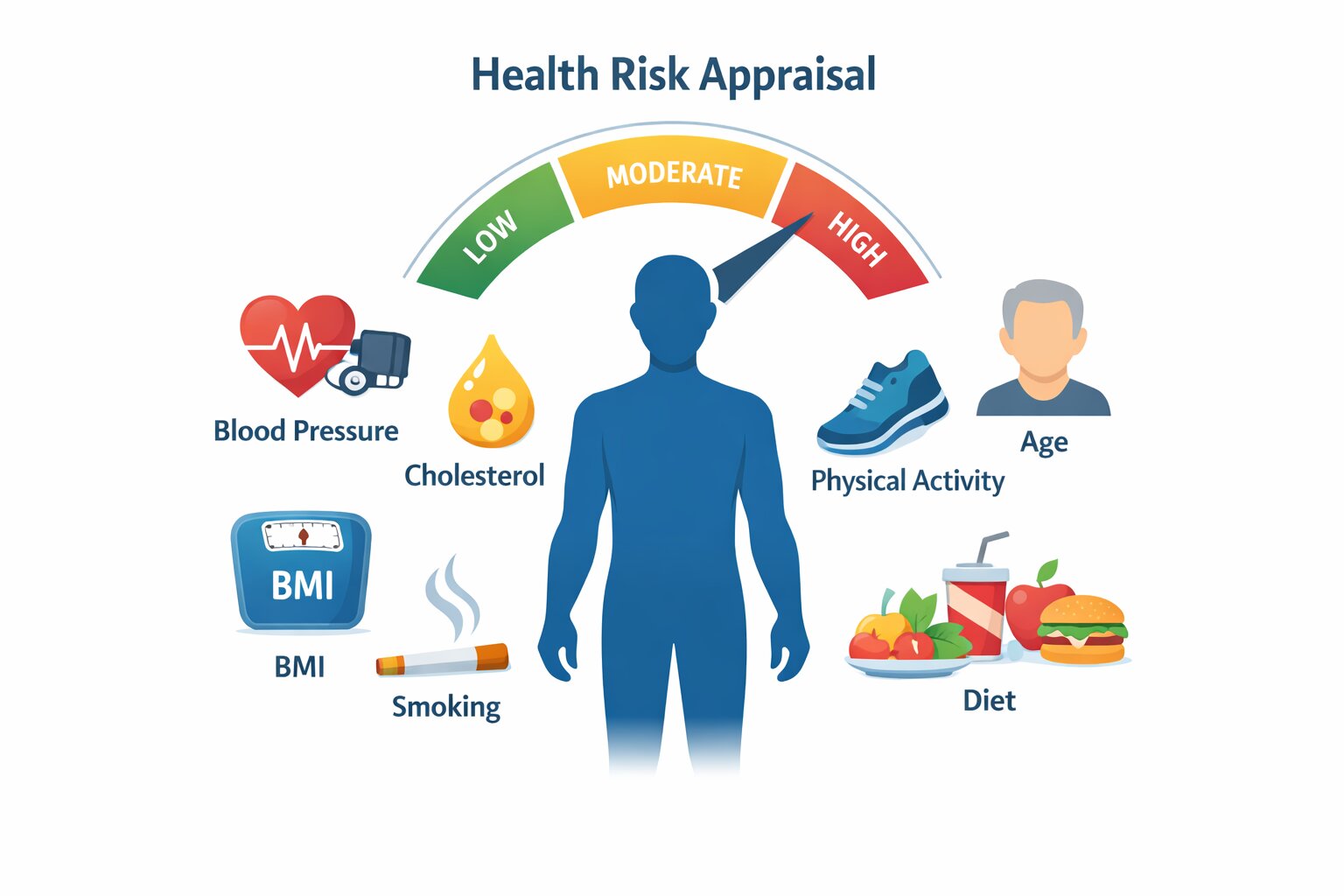
This comprehensive assessment evaluates your overall health risk based on lifestyle factors,
family history, and personal health behaviors. Receive a personalized health score and
actionable recommendations to improve your wellness.
Comprehensive Health Risk Assessment: Understanding Your Wellness Profile
A comprehensive health risk appraisal goes beyond simple biometric measurements to evaluate the
interconnected factors that influence your long-term health outcomes. This holistic approach
considers lifestyle choices, genetic predispositions, environmental factors, and psychological
well-being to provide a complete picture of your health status.
Comprehensive health assessment considers multiple interconnected factors that influence wellness.
The Science Behind Health Risk Assessment
Modern health risk assessments are based on epidemiological research that identifies modifiable
and non-modifiable risk factors for chronic diseases. The most significant factors include:
Modifiable Factors
Smoking status
Physical activity level
Diet quality
Alcohol consumption
Stress management
Non-Modifiable Factors
Age
Family history
Genetic predispositions
Gender (biological factors)
Interpreting Your Health Score
Your health risk score represents a composite assessment of multiple health domains. The scoring
system weights factors based on their proven impact on morbidity and mortality:
Score Range
Risk Level
Interpretation
80-100
Very Low Risk
Excellent health habits with minimal risk factors
60-79
Low Risk
Good health profile with few areas for improvement
40-59
Moderate Risk
Several modifiable risk factors present
20-39
High Risk
Significant risk factors requiring attention
0-19
Very High Risk
Immediate lifestyle changes recommended
The Role of Preventive Health Evaluation in Daily Wellness
In the modern healthcare landscape, the significance of a thorough preventive health evaluation is increasingly acknowledged. When a structured online health assessment is completed by an individual, a constellation of lifestyle, behavioral, and hereditary factors is meticulously examined. Rather than relying on the detection of overt symptoms, early warning signals are identified, and a foundation for proactive health management is established.
It is widely understood that many chronic conditions are preceded by extended periods of subclinical development. During these silent phases, subtle physiological deviations are rarely perceived by the affected person. However, when a reliable personal health risk calculator is utilized, these latent risks are quantified and contextualized. The interplay between modifiable behaviors—such as dietary patterns and physical activity—and non‑modifiable determinants like age and genetic susceptibility is algorithmically weighted. Consequently, a holistic portrait of one’s future health trajectory is constructed, and the areas demanding immediate attention are clearly delineated.
The data gathered from a comprehensive wellness risk test are never interpreted in isolation. Instead, they are integrated into a broader framework of preventive medicine. When a high risk score is generated, it is often recommended that lifestyle modifications be initiated under professional guidance. Conversely, a favorable score is received as reinforcement of existing healthy habits, though continued vigilance is always encouraged. The psychological benefit of such feedback is also considerable; when individuals are presented with a tangible metric of their wellbeing, motivation for sustained behavioral change is typically strengthened.
The components of an effective health screening questionnaire are carefully selected to reflect the most impactful determinants of morbidity. Smoking status, for example, is given substantial weight because its causal relationship with cardiovascular disease, respiratory illnesses, and various cancers is incontrovertible. Physical activity levels are evaluated not merely by frequency, but by the intensity and consistency of exercise, as these variables are directly correlated with metabolic health and cognitive function. Dietary quality is assessed through the lens of nutrient density and the avoidance of processed ingredients, as chronic inflammation and oxidative stress are known to be driven by poor nutritional choices.
Sleep patterns are scrutinized because restorative sleep is recognized as a cornerstone of immune resilience and emotional regulation. A deficit in sleep quality is frequently linked to impaired glucose metabolism and heightened cardiovascular strain. Stress management is similarly elevated to a key risk domain, as unmitigated psychological strain is associated with elevated cortisol levels, systemic inflammation, and maladaptive coping behaviors such as overeating or substance use. Even family history, a factor that cannot be modified, is assigned appropriate significance because it informs the necessity for earlier and more frequent clinical screenings.
When the results of a personal health risk calculator are returned, they are presented in a format that distinguishes between immediate and long‑term priorities. Modifiable risk factors that score poorly are highlighted as primary targets for intervention. For instance, if alcohol consumption is flagged as excessive, reduction strategies are outlined; if BMI falls into an unhealthy range, nutritional and exercise guidance is provided. The objective is not to induce alarm, but to equip the individual with a clear, evidence‑based roadmap.
The design of such calculators is informed by decades of cohort studies and randomized trials. Algorithms are continuously refined as new epidemiological data emerge. In a well‑constructed online health assessment, the weighting of each parameter is transparent, and the underlying assumptions are periodically reviewed by clinical experts. This ensures that the resultant score maintains both accuracy and relevance across diverse populations.
From a public health perspective, the widespread adoption of preventive health evaluation tools is viewed as a cost‑effective strategy to reduce the burden of non‑communicable diseases. When risk factors are identified early, the need for expensive medical interventions later in life is dramatically diminished. Communities that embrace regular wellness screenings report lower hospitalization rates and improved quality of life among their aging members.
The process of taking a wellness risk test is, by its nature, educational. As each question is answered, the user is prompted to reflect on their daily habits. This moment of introspection is often the catalyst for change, even before the final score is computed. Many individuals report that the mere act of quantifying their behaviors in a structured format reveals patterns they had previously ignored. Thus, the assessment functions not only as a measurement instrument but as a behavioral intervention in its own right.
In summary, the integration of a thorough health screening questionnaire into routine self‑care is championed by many health organizations. The knowledge gained from such an appraisal is empowering, and the subsequent personalized recommendations are grounded in scientific consensus. While no digital tool can replace the nuanced judgment of a trained clinician, a well‑designed online health assessment serves as an invaluable starting point for anyone committed to taking command of their long‑term wellness. The path to improved health is illuminated when risks are brought into focus, and the first step is always taken through honest self‑assessment.
About the Author
Dr. Rachel Greene is a board‑certified specialist in preventive medicine with over 15 years of clinical experience. This article was carefully prepared by her, drawing on the latest evidence‑based guidelines. Dr. Greene is dedicated to public health education and has contributed extensively to research on chronic disease prevention and digital health interventions.
Important Medical Disclaimer
This virtual health risk appraisal provides educational information and risk estimates based
on self-reported data. It is not a substitute for professional medical advice, diagnosis, or
treatment. Always consult with a qualified healthcare provider for personalized medical
guidance, especially if you have existing health conditions or concerns about your results.
Frequently Asked Questions About Virtual Health Risk Appraisal
What is a virtual health risk appraisal?
A virtual health risk appraisal is an online assessment that evaluates your overall health risk based on lifestyle habits, family history, and personal health behaviors. It provides an estimated health score and practical recommendations to support preventive care.
How does this health risk appraisal work?
This tool analyzes information such as age, BMI, physical activity, diet quality, sleep, stress, smoking, alcohol intake, and family history. Each factor is scored and combined to generate an overall health risk score.
Is this health risk assessment a medical diagnosis?
No. This virtual health risk appraisal is for educational and informational purposes only. It does not diagnose medical conditions or replace professional medical advice.
How accurate is the health risk score?
The score is an estimate based on established public health research and self-reported data. Accuracy depends on how honestly and accurately you answer the questions. For clinical evaluation, consult a healthcare professional.
What factors most influence my health risk score?
The most influential factors typically include smoking status, physical activity level, diet quality, BMI, sleep habits, stress management, alcohol consumption, and family history of chronic disease.
How often should I take this health risk appraisal?
Most people benefit from retaking the assessment every 3 to 6 months, especially after making lifestyle changes, to track improvements over time.
Can this tool help with disease prevention?
Yes. By identifying modifiable risk factors early, this assessment can help guide healthier lifestyle choices that support long-term disease prevention and overall wellness.
Who should use a virtual health risk appraisal?
This tool is suitable for adults who want to understand their health profile, identify potential risk factors, and receive personalized wellness guidance in a convenient digital format.